
Robots and humanoids have long been a discussion in cinema, tech, and company keynotes. Many fortune 500 companies have already been developing in robotics over the years, in forms of assembly and consumer products such as drones and robotic dogs. Nonetheless, technology is almost at a pace to catch up to man, and one company chooses to redefine the humanoid industry.

On this weeks pod, the robotics team discusses the advancement of China’s Unitree G1 Humanoid Robot and the barrier of limitations when it comes to manufacturing and developing humanoids. The company defining the humanoid market got it’s launch out of the DJI playbook: own the hardest part, sell something cheap and breakable, and let the domino effect begin. The team calls it “China’s scaling law,” the oversupply strategy working yet again (00:14:22).
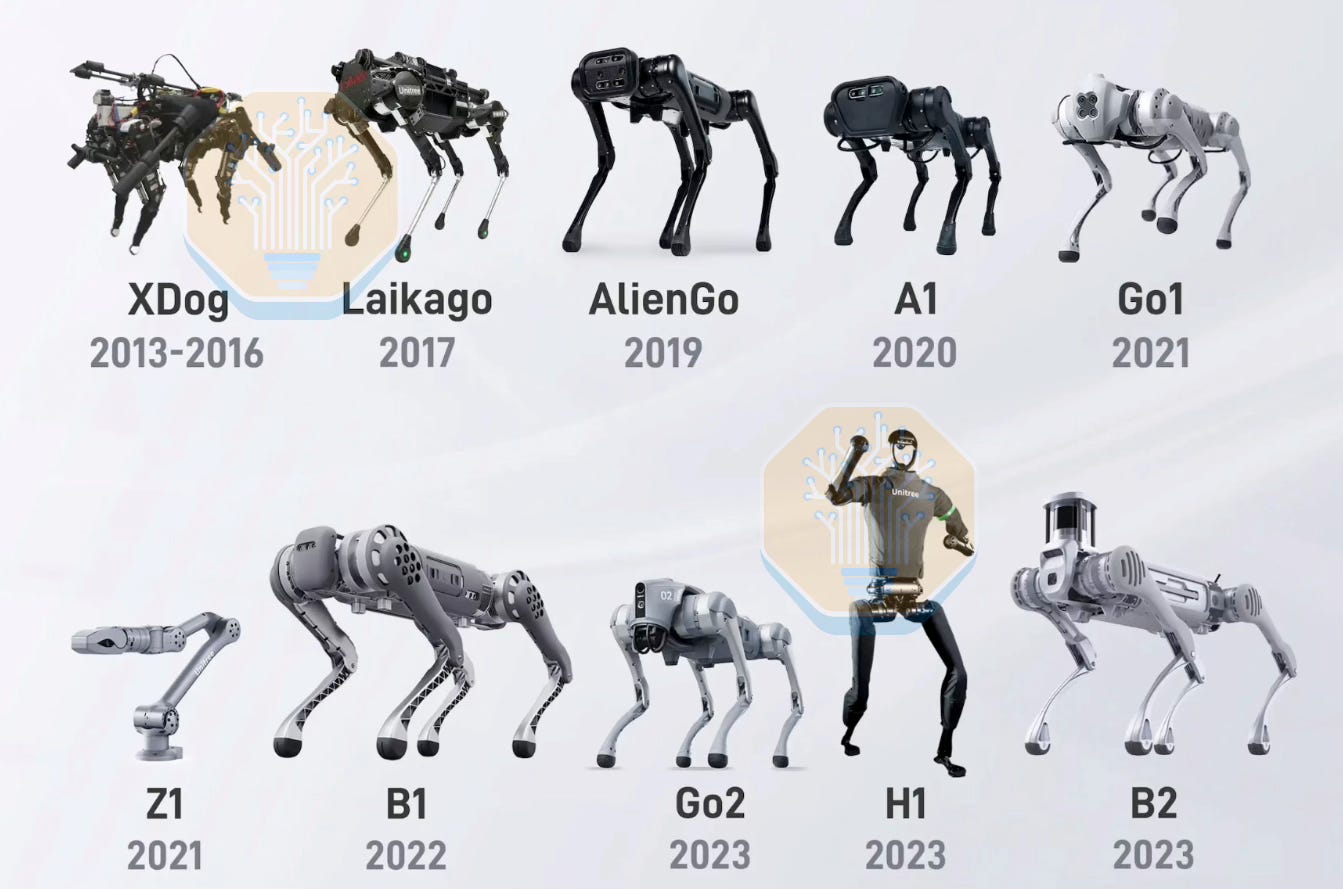
In Hollywood we’ve always been handed robots fully formed and full of life, Unitree diverges from the theatrics. The actuator, a joint that drives a robot’s limbs, eats more than half the building cost yet necessitates a majority of the functionality. By collapsing quadruped prices from tens of thousands to a few thousand dollars, the company bought years of production volume on the exact parts a humanoid needs (00:04:28). The first humanoid, the H1, was effectively a quadruped standing on two legs, bent knees and an awkward gait giving it away (00:45:42). Less a robotics breakthrough than a manufacturing one.
The advantage? Is the world behind the product. The team walks through the Shenzhen electronics markets, where a builder can show up with cash and leave with every part for a drone under one roof (00:28:03). Unitree self-produces the motors and gearboxes its own rivals outsource, so its margins climb while prices fall. The same path BYD walked with batteries and DJI with controllers: own the bottleneck, own the market.

When it comes to discussing the geopolitics in humanoid development, discussions arise how China is the dominant player in the industry. The example about China holding nine out of ten of the topsolar panel companies is a template at how a dominant China can trump a niche market (00:06:43). America’s position is mostly aspirational by comparison, short on neodymium, thin on board manufacturing, tied to a chemical supply chain routing through China regardless (00:42:17).
The math behind it all is a true precursor for the conservative assumptions a Unitree can undercut human labor on repetitive, assignable tasks (00:24:08). Although it doesn’t have to be well made, it only needs to be sufficient to push future generations. As the team wraps their discussions, they do begin thinking of the real world examples they would like to incorporate humanoids to do, such as folding clothes or doing the dishes (00:47:38). Things may no longer be as science fiction as they used to be.

Join SemiAnalysis Weekly for expert insights into the semiconductor, AI infrastructure, and robotics markets. For deep dives into AI supply chain, chip economics, and market analysis, find us on YouTube and Spotify.
AUDIO & TRANSCRIPT:
The conversation between Jordan Nanos, Reyk Knuhtsen, and Niko Ciminelli is transcribed below, lightly edited for length and clarity.
Jordan: Hey everyone, this is Jordan. Welcome back to SemiAnalysis Weekly. We’re jumping right into it with Niko and Reyk this week to talk everything Unitree... their upcoming IPO, humanoid robots, and a few of the previous robotics articles we’ve done on levels of autonomy and quadruped state of the market. Hope you enjoy.
So, in terms of how many deployments are actually real in the real world... it seems like robotics is just getting started, on the cusp of taking over entire manufacturing plants, or...
Niko: ...Not even. Even in the industrial deployments. In our writing, I’d say we gave them a generous framing. Their improvements are very material, but with the burnout rates, the payload, and the internal accuracy of the hardware, we’re in baby days, to put it lightly. I’m actually not entirely certain. Even among the partners, we’re trying to get metrics on what this would look like. I think they’re defining industrial deployment very broadly. Most of these robots are showing people around places and whatnot, and at best, the frontier of deployment is telling them to pick up boxes and things of that nature.
Now, I don’t think that’s true for general robotics as a whole, but the research playbook for them has been huge. So industrial deployment being real, maybe that’s true for robotics as a whole. The pace of progress on Unitree is on a bit of a different axis. The general point we’re trying to make is that it’s getting there really fast, into a more capable set of hardware form factors.
There’s Unitree, there’s the research market, which is a thing nobody took seriously. Then there’s robotics as a whole, which is starting to get AI capabilities. Really early days, but we are seeing it. And then there are form factors that are obviously industrially useful, but those are more sophisticated and more expensive.
Reyk: Yeah. We weren’t trying to make the argument that, broadly, industrial deployment like this works, that it’s super viable now, that you can just drop it in anywhere. It’s not totally the case, right? You have to think about all the throughput and the reliability factors. In our article, they still burn out quite a bit. But the point being, even on the smallest task, it kind of works. And that’s all that matters, because a while ago, nobody actually took them seriously at all.
Jordan: Yeah. So why are they going public? What are they going public on?
Niko: In China, companies go public a lot faster. Sometimes it’s in the terms, that you have this many years to go public. Sometimes you’re liable for the capital. You guys know this as well as anyone, but I think it’s kind of a necessity for them. And also, the revenue is not small. The market they’ve carved out for themselves is growing and sustainable. They are the dominant form factor for those use cases. It’s easy to use. The developer kit is improving.
Jordan: You say revenue is healthy, but that’s just for being a tour guide.
Niko: Yeah, but also the research and development and hobbyist market is a bigger market than people internalize.
Reyk: And to be fair, revenue is healthy in the sense that they were charging a lot for these robots before. Quite a bit. Even in our BOM, where it’s like, hey, at a $27,000 pretax price, these are still 67% gross margins. Which is absurd. And it’s mainly because there really aren’t that many players that are going to bring down the price yet. So it’s just Unitree in there, gouging the living hell out of the market while they can. And presumably these prices just keep dropping. But a big reason for the revenue being so large is that you could charge $54,000 before for robots that would burn out in five minutes, and now it’s $30K. So it’s huge drops.
Niko: They’re also able to produce at scale, at a unique scale, and their iteration cycles, their improvement, and the engineering are super, super fast. So they’re trying to burn the bridge behind them a little bit. If I drop the cost of this robot... the American bots might be trying to go all the way, 0 to 100, perfect dexterity in the hand, strong payload, make all the new innovations. Their bet is, I’m going to make an extraordinarily cheap robot.
And by the way, we’re also all trying to figure out the software, how to solve the controller, how to do interesting AI models to make robots useful. Turns out, for the experimentation you need, the hardware has to be cheap and useful, it’s going to break, and you want a good service time. These things need to be experimental, and they’ve increased their hardware capabilities as they’ve grown as a company. So it’s a bottoms-up approach to growth, in a way that’s very amenable to DJI-like capabilities.
Jordan: Yeah, I understand the comparison to BYD and DJI because of the “burn the bridge behind you” thing you described, which seems like a reasonable competitive tactic if you want to take the whole market and you have the ability to do so. But in both of those cases, it seemed like there was a healthy market for drones and for cars before those entrants came in. Maybe EVs or autonomy was a different part of it, but there were a bunch of players.
Robots, specifically humanoids... it’s not like there’s an incumbent they’re trying to compete against. They’re pretty much defining the market and growing with it. Which makes me think about solar panels, and how China has like nine of the top ten players in solar. So, do you believe they’ll have competition in China, and they’re just pulling up the ladder against the US?
Niko: I think the article’s core purpose, in all seriousness, is a few things, but one of the main motivators was trying to communicate the importance of economies of scale in this market. There’s obviously a ton of AI tailwinds, that’s the obvious point. People bought cars for a while for BYD; EVs are a different situation. But this is an obvious thing that’s separate and different. Drones are similar in this regard. This is definitely an AI demand pull. Language models have become extraordinarily powerful economic vehicles and tools, and robot models, from a research perspective, have shown their early signs of life. I don’t think anyone wants to wake up one day and say, “Oh wow, we missed that boat.”
China has been a huge leader in industrial automation in general. Their robots per worker are higher than the US. This is more classical industrial automation, single pick-and-place, things for mobile electronics and so on. But even their co-bots are getting much stronger over the years, and much cheaper. They’re not as reliable as some of the European and US ones yet, but they’ve improved rapidly. This has been a really big mandate in China anyway, extraordinary amounts of automation. So they’re well positioned because of what they’ve done in consumer electronics and automotive markets, to see this as a serious thing given the markets they’ve done well in before.
So between the fact that this is within their core advantage already, the things they’ve grown very heavily in, consumer electronics and automotive, and the fact that the AI tailwind is very clear, it’s allowed them to be forward-thinking about how to build the hardware ecosystem early in the progress of AI.
Reyk: And I want to add here, Jordan, you’re poking on a good one with the DJI comment. DJI sold into the drone market, but in the paper we really try to point out that there was no consumer drone market. It wasn’t a thing. You go back to the early 2010s and it’s a bunch of dudes in their moms’ basements building drones for maybe a couple thousand dollars, or you go buy the $20,000 one that’s basically military grade. So there was no sector for this to begin with.
Then DJI comes in and brings out a product that’s pretty mediocre now, but at the time was kind of groundbreaking, because it was affordable, it was functional, it had a camera, and it was stabilized enough to be a useful drone for anybody who actually wanted to use one. And then all of a sudden... and this is where it’s nice to remember my numbers... after that first release, I think they went up to like $100 million in revenue over two years or something. And it was like, oh.
Niko: Yeah.
Niko: I’d say it was $130 million. Yeah.
Reyk: Yeah. And it was like, oh. So this market didn’t exist before, but you can just invent one, almost. Show people it’s useful, make it cheap enough, and customers will just arrive. That was the DJI move there a little bit. And Unitree, you know...
Jordan: You’re talking about DJI. I’m going to throw this on screen so we can take a look. And the numbers you’re referring to... 4 million?
Reyk: 430 million. Crazy, right? And it’s not to say that Unitree is booming and originating the whole humanoid market right now, because it’s so small, it’s hard to totally declare that. But hey, if it happens... we pointed this out a little bit. This is a pretty competent company. They’re creating robots that are becoming moderately useful at a reasonable price. In the past, this has been really successful for initially getting a customer base, then scaling upward, growing and getting better. And now DJI is just everywhere.
Niko: It’s not a super galaxy-brain take to say that, just like drones, people had a very strong interest in them. But they were this novel, extraordinarily expensive technology that was basically licensed to governments or people who could afford them. There’s a surprising amount of people in the market, both small companies and hobbyists, where, to Reyk’s point on the drone side, it’s really a cost problem.
Unitree has essentially doubled down on the fact that when they made their quadruped cheap enough... people questioned very seriously, what is a quadruped market? Now, you can make the industrial argument that there are enormous amounts of progress-tracking and security use cases that I think people deeply underrate. But that’s not the main thing quadrupeds are selling themselves into. People want to buy a robot dog and see what they can do with it. Whether these are extraordinarily non-technical people playing with Claude Code and running experiments, social media influencers, or reasonably competent engineers throughout Europe, the US, and China who are just trying to see what this technology really is... if it comes down to a reasonable price, where someone on a white-collar wage can save up to buy it, there’s a surprising number of people who want to play with it, the same way they would have with drones.
The deeply peculiar part about all of this... and this is a pretty awesome chart to bring up around now... a few years ago this was a quadruped company and people really didn’t care about them. One of the motivations of the article is that this was a quadruped company, and through economies of scale, finding a market that really wants the product, they’ve been able to bring the cost down, improve their hardware, make their engineering more reliable, and improve quality across the board, making a product that people love, which has given them the mandate of heaven to make the next product. And because they have that mandate, they’ve gone up the stack of capabilities, shrunk the cost, and opened up a wider and wider market every time. As they grow as a company, they’ve been able to make products that are more and more capable.
I tell this to Reyk pretty often as we work through the articles we collaborate on: economies of scale is China’s scaling law. We’ve seen this time and time again, the oversupply strategy really working well within China. We’ve seen it several times now, with enormous businesses that started in funky, weird ways and surprised people, because they just don’t stop iterating and they don’t stop innovating.
Jordan: You guys both seem very convinced that demand for humanoids is just obviously going to be there when the cost drops and the quality improves.
Niko: Quality of both AI capabilities and hardware. Yes.
Jordan: Yeah, yeah.
Reyk: This is kind of the argument in our levels-of-autonomy paper. I’ll harken back to that one for all the readers who remember it. The point of Levels of Autonomy was to show that you don’t need the highest capability to be a useful robot. You can be doing very basic tasks. That’s why we had the quadrupeds paper, where it’s like, okay, Unitree has good quadrupeds, great, what does that actually mean? It’s just a dog walking around, who cares? But then, oh, you can actually find some use cases. You can have it do scanning at construction sites, which is a very expensive job, doing all the captures. You can maybe have it do delivery in some locations that are really bound by size, where it’s weird to get a car in, so it’s economically challenging that way.
So my humanoid doesn’t need to be perfect. It really doesn’t. It just needs to be able to do a few things I want it to do, and it needs to break even on a cost basis with a human doing it. That’s where we get to that whole heat-map scenario, where we show... we’re not telling you this is a phenomenal robot. We make it very clear, this is not the cream of the crop, the perfect robot right now. But listen, even with all its challenges, even if you assume 100% teleoperation, even if you assume a mean time to failure of one every 20 minutes, with five minutes to repair, so 15 minutes of uptime or whatever... and you compare it to a human doing this task, it’s actually just a little bit better. It’s just good enough that you can put it in a warehouse and have it do something.
And we don’t have it doing the craziest task. We’re not telling you it’s moving 200 things a minute out of a box and has to think a lot about how to sort it. No, it’s just taking this box and putting it right there. Very basic. But that’s a whole job. That’s a whole job.
Jordan: Yeah, yeah. Okay, you’re making me think of an analogy to the ChatGPT moment in 2022, maybe the Claude Code moment a couple months ago, six months ago, a year ago. It seems obvious to me that demand is there, but we’re also going through the experience where there’s an indication this is going to be incredibly useful in the future, even if it’s narrowly scoped right now. You don’t think there’s anything obviously limiting the hardware from improving on reliability, and the software, or general operation, from improving on quality, so it can do more and more economically valuable tasks more reliably over time?
Niko: I think there are a few things to this. What is the ChatGPT moment? I tend to take that as a bit of a misnomer. The reason I say that is, when we got Sonnet 3.5 or 3.7, depending on how religious you are about when code came online... I don’t like to talk about code being solved, because code has become extraordinarily more capable from language models. I don’t think many serious people would call it solved, but it’s gotten very useful.
Robots, in order to deploy, need to reach a certain level of nines of reliability. You’re not really a complement for very long, an economic complement. You’re trying to replace an individual unit of labor. I wouldn’t say replace a person, but you’re adding to capacity that would have been someone who’d done that task. Now, what does that actually look like in practice? It might be legitimate teleoperation, a cheaper person from another geographic region controlling the robot. That’s ideally a very high level of autonomy, potentially corrected by a person, and hopefully that person is helping correct multiple robots at once. And these things don’t have to be just humanoids. We see a lot of arm manipulators on wheeled bases. To Reyk’s point, things scale up over time and the hardware will improve over time.
The claim we’re broadly trying to make is not that there’s not a lot of work left to go. People have debated whether there will be tendon-based arms, or going the way Wuji and Sharpa are doing, which requires enormous precision and great machining. These are very difficult problems to solve, on the hand still, today. Whether or not you even need a hand depends on the use case. We have a long way to go on the software and a long way to go on the hardware. The same way, when code came online, we had a long way to go for autonomous research, and even for things in white-collar work that aren’t code, in less verifiable domains. In the same fashion, some things will come online for robotics that take a lot longer due to reliability. But you get this interesting way to look at the problem, where you say, hey, you do get enormous demand shocks that are extraordinarily powerful, that pour an enormous amount of capital into the ecosystem, that I think people don’t deeply internalize.
Jordan: Can you explain the kind of demand shock you’d foresee happening?
Niko: As the price comes down and the capabilities increase, some go-to-market opportunities will offer enormous amounts of pull, capital into the market, talent into the market, investment, and customers.
Reyk: Yeah, for example... we highlight a few of the use cases in the autonomy paper, where you’re at the point now where your robot is capable on a few axes: throughput, reliability, and the failure tolerance of the task itself. In the autonomy paper, one of my favorites is the cooking robot, where it just uses the two arms to stir some onions. Super basic. I can’t really botch that. I have a timer in my head, I can see how hot the pan is, I’m not going to burn anything. So now you’ve got, okay, the robot can cook. How many line cooks are there globally? This is a huge pool that just opened up, just because the robot knew how to stir the onions. That’s a big demand shock, like Niko was saying, that comes from something like that. Or it’s like, oh, it’s doable, I guess.
Niko: And again, shout out Cloud Chef. The fun part about this is what people forget in Western markets particularly: we’re having enormous attrition in some industries. So when Reyk’s point is, why do we only have to be a little bit better than a person... what does that really mean? Let’s say the robot still isn’t at human speed. It depends on the requirements of the task. Is it high throughput? Low throughput? A high-mix task where you’re doing a bunch of different things, or something reasonably constrained? There are different ways to break that down, relative to whether the failure mode is catastrophic. You can break down traffic, failures, are you hurting someone, are you breaking something expensive? So you can break this task down a few ways: what’s ready and what’s not ready.
But we want to look at something called the loaded cost of labor, which is not just how much you’re paying someone. If it’s a minimum-wage job, which many of these robot applications are not... minimum wage tends to scale linearly over inflation and regulation, it’s relatively linear over time. But the loaded cost of labor has been somewhat nonlinear in places like the US and Europe, where people are quitting at higher and higher rates. Hiring gets more expensive, you have to invest more, and that makes onboarding someone, skilling them up, and finding people really difficult for the business. So if you can get a robot that works at half the speed but runs two shifts, or maybe once you get it to 70% as fast as a person the speed requirement doesn’t really matter anymore because your output ends up higher, or maybe you don’t need rework, maybe the robot doesn’t make as many visual mistakes... it might be slower, it might make manipulation mistakes, but maybe it doesn’t make visual mistakes. That’s usually what you tend to see.
So the unlock for an application happens across many axes. It’s very domain-specific. When we talk about these demand shocks, they’re going to come in many forms. They’ll come through businesses that are entirely robot-oriented that were service-based. They’ll come from things like cooking, things like kitting. Insertion tasks will come online reasonably soon, depending again on the level of catastrophic failure. We’ll see a lot of things.
Datacenters are the really fun one that a few folks are going after, which I’m pretty ecstatic about, because the cost of electricians, talk about nonlinear prices... you guys have called this out a few times, a lot of the AI fast-takeoff folks are like, everyone’s going to turn into an electrician, we’re all going to turn into electricians, that’s going to be fun. That sounds like a really awesome way to spend my day, unplugging and plugging in server racks for all of society, all of us competing on this stuff. But the thing is, the market for that is massive right now. Whether it applies to neoclouds is uncertain, just because of their scale, how fast they’re building out, and so on. But with the massive infrastructure buildout, even on bring-up there’s enormous value. People underrate maintenance and how sticky that revenue is going to be. Datacenters are sometimes in remote places, and sometimes it’s hard to find a very skilled electrician. These are serious things.
The robot’s advantage on a task isn’t always just pricing on the labor. Sometimes it’s an enormously high-value-add use case where the business really highly rates it and will pay a lot for it. And that’s not just datacenters. It’s the case in construction, logistics, and other tasks too. We’ll see new businesses built on this, where people do things in a robot-native way, not just an AI-native way. I’m quite excited for things like this. And that’s not just a Unitree thing. You see other form factors, other companies.
Jordan: Yeah, we’ve been covering a lot of ground so far, talking about not just the humanoids, but obviously...
Reyk: Exactly.
Jordan: ...quadrupeds, all sorts of robotics, which I think is all related. But maybe we can go back to one of the points from earlier. I think there are two things. If we’re comparing the humanoid market specifically to previous markets a Chinese company has entered and then dominated, whether it’s drones, solar panels, electrical, or consumer electronics, you say economies of scale is a key critical component of that. I’m curious if you can talk a little bit about the Shenzhen consumer-electronics ecosystem that powered some of the existing ones, and how that might come into play here specifically.
I’m just going to show this picture on screen that I love from the article, where you can see... so cool... you can just visually see the supply chain.
Reyk: The scale of this thing. Yeah, it’s amazing. It’s Huaqiangbei. I’m totally botching that name, but yeah.
Jordan: I’m taking it for granted a little bit. For the people who are audio-only, this is a picture of a...
Reyk: This is Huaqiangbei, an electronics market in Shenzhen, I believe, where it’s a seven-story building of just consumer electronics parts. The entire supply chain for consumer electronics, just in this tower. It’s unbelievable. You can go in there and buy your microcontrollers, any field-oriented controller you’re looking for, any camera, any IMU, whatever you want. You show up with your yuan, throw it down, walk out, and you have every single part you need to build a drone, all within a single building. It’s phenomenal. And it’s just one part of the whole Guangzhou, Guangdong, and Shenzhen area, the Pearl River Delta. Everything is in this region. I totally did not answer your question on the economies-of-scale thing, but, yeah.
Jordan: No, but let’s tie it into what I thought was the coolest graphic in the humanoid Unitree article, where you go through the BOM of one of these humanoids. There are arms, waist, head, torso, legs, and all of these individual components. Conceptually, I can zoom in on just one, like the torso. There’s a battery system, a CPU board, an Nvidia Jetson NX, maybe that one’s a little different. The legs have gearbox motors, joint drivers, linkage bars, bearings. If you look at all of these components... can you talk about the supply chain in the humanoid context and how it compares to what China has done with consumer electronics? What components are shared? What already exists? Is the whole supply chain just already done? What’s it like?
Reyk: Yeah. This is a bit of an overstatement, but I think an okay portion of this was already helped out by the original consumer-electronics market. Most of your standard controllers come from that original supply chain. There’s injection molding for your plastics, there are motors, which are pretty standardized nowadays. We’ll get to the humanoid aspect, but the point is, a lot of the base components are pretty common throughout China.
What’s interesting in the Unitree and humanoid case specifically is that you’re watching an ecosystem form around it right now. Not Unitree specifically, but the Chinese humanoid market, where people are now making a lot of these planetary gearboxes, which is what goes in a Unitree arm to make it move correctly. People are making a lot of these in the right spec and size, which wasn’t really necessary a few years ago. Drones don’t really use gearboxes, mostly just high-speed motors. These are cropping up. Every province now has somebody that cuts your gears. Nobody actually needed these gears before.
And then you look around and... I think there’s that one article where there are 200 humanoid companies in China now. All of these keep cropping up, and that massive number of companies showing up is what drives all of these new suppliers, who come in and say, hey, I’ve got a gearbox for the low, I’ll sell it to you, be my customer, we’ll do this together, we’re going to get on the humanoid wave right now. And now you have this whole supply-chain convergence onto certain architectures that worked really well for humanoids, that just doesn’t exist outside of China. Not at meaningful scale. So you’re watching this build in real time, and Unitree is actively benefiting from it. I could really gush over the BOM, but I’ll withhold for now.
Jordan: But, well, maybe...
Reyk: Maybe.
Jordan: A little bit. Maybe we can extend this to how it influences the development of the next versions of the systems, and specifically the reliability and thermal problems people are seeing right now.
Niko: Yeah. One thing to harp on too: it’s not just the mobile side. Again, we’ve mentioned not just DJI, not just the fact that they have a few phenomenal phone companies in the country that have grown at extraordinary rates over the last decade or two. It’s their automotive. The contract manufacturers for a lot of these robotics companies are the same contract manufacturers, or adjacent talent to them, that allowed the automotive market to grow to the size it is today, and it’s why it’s still growing so massively.
The reason the electronics market exists is that they have an extraordinarily diverse ecosystem of many, many small players. I’m forgetting the term, which is a huge shame because it’s going to be misquoted, but a friend of mine talks about this as “a sea of a thousand bosses.” There’s some guy who’s the best in the world at making a specific component, who’s been doing it for 20 years for some number of customers, who knows so well how to get the right yield on his machines, how to improve them, how to make the part perfectly and quickly so you get it the next day. And they’re all competing. He’s got some absurd number of customers relative to the US, and if he can’t make that part at the level of quality, precision, and reliability where the economics work for him, where he can keep lowering the price because they’re super competitive on price, he can’t survive.
Their competition allows the consumer of the different vendors to benefit from an extraordinarily price-competitive market. Their quality has basically come from the pressure of the internal community to survive on their own. And this comes from the fact that you have several hardware markets that are all benefiting the level of complexity and technology required to make things like humanoids and other form factors. The fact that they have a diversity of technology to experiment across the spectrum is where they get these ecosystems from.
This is not a new ecosystem for them. It’s a derivative ecosystem. That’s the thing people really don’t get. When our production for Apple went over there, when we built up their supply chains from the US, they haven’t stopped. They’ve made newer, stronger, cheaper products, and their manufacturing processes created this massive second-order effect of businesses that serviced all these large companies as they grew, becoming extraordinarily competitive markets where they got really great, a wealth of domain knowledge that allowed them to survive. So yeah, these things matter a lot.
Jordan: Yeah, makes sense. Okay, I’ve got one last question and then we can wrap. We covered it a little at the beginning, but maybe you can do it in more concrete terms. The whole theme of this podcast so far has been quite positive, there’s a lot of excitement around humanoids specifically, but there are big differences between deployment reality and hype right now. We started out talking about that a little. But let’s say there are 100-plus humanoid companies and provincial competition in China. Can you make the bear case for Unitree, where somebody comes along and out-competes them for the entire humanoid market, or they have less success than you’re currently expecting? What would that look like? What are the challenges they still need to overcome?
Niko: Yeah, this is difficult. I’m not going to sit here and say I have a magic crystal ball to see how this plays out in perfect form. There are many players emerging. There’s a new humanoid company in China every week, it feels like, and they’re building robots. It used to take several months to spin up something that looks remotely okay, and this gives a lot of credit to the supply chain. You’ll see a new company come in, like, oh yeah, in two weeks we just made this robot and it’s walking, and it does a triple-axis backflip and all these crazy things. Now, granted, the dancing isn’t that big of a deal, to be honest.
Jordan: Really? What’s your favorite demo you’ve seen so far?
Niko: I’m boring. I want things that are hard for a robot to do, which is repeatable precision.
Jordan: Like stirring onions? What do you mean?
Niko: To be honest, I’m a big fan of datacenters. I want to see assembly, I want to see these things put together a bike. I want to see force and torque, janking things around. Real dexterous manipulation that requires force-and-torque understanding. A clear path to having that directionally figured out, just scaling up what they’re doing today.
Jordan: Yeah. Right. What’s your favorite demo?
Reyk: The Spring Gala. You can watch that video. That video kicks so much ass, I’ll be honest. That video rocks. You look at it and they’re doing the parkour over the boxes. That video is incredible. Huge fan of that one.
Jordan: We found a disagreement here on the podcast. Finally.
Niko: It’s not easy for me to dance, but the robots are born to dance. It’s low accuracy, they can fudge around, they can land on the wrong spot and it’s still going to look cool. It’s better than me, so I can’t really talk.
Jordan: Did you like the performance in the marathon?
Niko: That’s a really big showcase of the burnout not happening as long anymore.
Reyk: Yeah, exactly.
Niko: That’s just cool, actually.
Niko: The fact that they can run long distances now is scary from a Terminator perspective, but really impressive in terms of how far we’ve come with how long our motors last. So I’ve got to give it to the guys.
Reyk: We’re too practical over here, Jordan. But I will say, I do like the social use cases of these things. And to be clear, I don’t want this segment to be us making Unitree into a joke. But I do want to point out that these robots are pretty funny. Big fan of the ones where they have them walking around the street just saying outlandish shit all the time. Big fan of those ones. Don’t get me wrong, they’re not exactly demos.
Niko: Yeah, people love the bots. People love the bots!
Reyk: Come on. It’s this four-foot-eleven dude just walking around saying whatever, and it does backflips, not bad for us, and it’s doing dances and stuff. It rocks. Happy to have this guy around.
Jordan: That reminds me, I think I saw one of our colleagues ask one on a date a few weeks ago.
Reyk: I heard about this. I heard about this. Shout out to Michelle.
Reyk: Hope that one went... wow.
Niko: Godspeed.
Niko: Yeah. Do I think Unitree is going to have some serious competition? Yeah, 100%.
Reyk: Yeah.
Niko: Are they in position to benefit? It’s more about the strategy. Unitree is an emblem of what China has been able to do, and they benefit from their ecosystem. Every bot produced right now, even in the US, benefits their ecosystem, because our supply chain heavily relies on them. So they benefit from themselves, and they benefit from us currently.
Jordan: And the customer.
Niko: Is Unitree going to get some competition? Yes. Are they going to be a great business? I’d put my money on it. If you’re going for a handshake bet, I say they’re going to be a good business.
Jordan: You guys said this at the beginning, right? This is Silicon Valley-based startups raising venture capital to develop robots for all sorts of areas, who then take that capital and buy Unitree humanoids to put in a warehouse in San Francisco. And that’s maybe the biggest part of their business right now, R&D for future stuff.
Niko: I think the warehouses, as an example, were a test case for us to show that some people were attempting to go to market with them today. I’d be hesitant to say that’s the majority in any form.
Niko: The majority of the use case is universities. Granted, things are changing now with new government regulations that will curb that quite a bit. But Unitree has done a really strong job of selling to researchers who need low-cost robots that are still usable, serviceable, and strong, good for training AI models with.
And by the way, I do say this very seriously: I am bullish on the US being able to compete in this market. It’s going to be very hard. But the US does take this increasingly seriously. Making sure we have some form of our own supply chains is very, very difficult. I think we’re underinvested massively. We don’t have metal processing, our neodymium production is too low, and even if we have the chemicals to set up processing plants, they’re still going to come from China. We don’t make a lot of the picks here, we don’t know how to make them. We can wind actuators, but we’ll still have them produced mostly in China. These are really big problems.
But the necessity, as AI progresses, is going to encourage massive, massive investment. Right now, China is in a phenomenally advantageous position. And to me, this article was also trying to be a wake-up call, saying you don’t have to believe we’re at what the optimists dream of, what Figure dreams of, having a full-fledged 0-to-100-level humanoid, to see that this market is moving. The point of the article is that this market is moving. The technology is showing signs of life in a unique way, and the supply chains are very clearly feeding into an increasing attractor state over time, where their advantage isn’t going away anytime soon. To look at them like a car company, when they were just a quadruped company a few years ago... I wouldn’t ever count these guys out, because they’ve already shown enormous progress. But I’m sure, at the rate we’re going, we’ll see a lot more from different companies in China, and the US will put quite a bit of effort into this as well.
Reyk: Yeah, the fact that they’re even getting into this market at all is significant. This wasn’t even in conversation a year ago. I want to harp on one thing here, because it’s a bit more anecdotal. Part of it’s not in the piece and part is, but it’s a bit looked over: the scaling of the Unitree project as a whole.
Like we mentioned, they came into quadrupeds, boom, okay, great, quadrupeds work, 95% cost drop, we’re shipping tens of thousands of these things now, excellent. This works, number one. But we couldn’t draw a perfect one-to-one correlation, so the paper doesn’t say this explicitly, but in my heart of hearts, the idea was: you get your actuator for the quadruped good enough, and a lot of the systems designed for the quadruped good enough, a lot of the actual mechanics, the parts you’re putting into the robot, you get this good enough, and then you can transfer a lot of the components toward a humanoid. Which is what the original H1 technically was.
In the piece we mention this, it’s such a good data point. I love the guy for telling me this, someone close to Unitree. The H1 was originally designed as a quadruped standing on two legs. You look at it and it’s so crazy, it looks bizarre. The legs are already bent like a quadruped’s. You watch it walk and it does this thing where it patters its legs a little. It’s designed to be a quadruped on two legs, basically.
So you go from that, and then you look at the G1, where they shipped, what was it, like 400 in the beginning of 2025. Then it suddenly jumps to 4,000 over the next nine months. And then three months later, in January, they say, by the way, we’re at 6,500 right now. You’re visibly seeing the scaling happen in real time. It’s unbelievable what they’re doing right now. Early stages, obviously, but this is super impressive.
Jordan: Yeah. Okay guys, we’ve got to wrap here. This has been great. Anything you think is left unsaid?
Reyk: I hope not.
Niko: Early stages are here. I think it’s no longer sci-fi, and it’s going to get increasingly weird over the next four or five years.
Reyk: First inning. Play ball.
Niko: And yeah, the game began. The game began.
Reyk: Would you get a G1 in your house, Niko? Or would you get an H2 in your house?
Niko: I’m a little security-concerned. I do think these things are real. I do think geopolitics is going to get very peculiar. The US needs to prioritize this kind of stuff, we need to figure out our own supply chains. Unitree’s a phenomenal company. How these things develop is going to be... yeah, to put it lightly. Would you get one, Reyk?
Reyk: It would just be kind of freaky to look at it in the hallway. That’s my only problem. I wake up to get a glass of water and it’s this six-foot dude right outside my door.
Jordan: Start with a roommate.
Reyk: Yeah, yeah.
Niko: I want a robot folding my clothes. I’m pretty excited for home robots.
Reyk: Yeah, I’m excited for the clothes-folding robot. It doesn’t need to walk and look like me, but I could do a clothes-folding robot. That’s fine.
Niko: Put a Hawaiian t-shirt on it, it’ll be fine.
Reyk: Yeah, put some sunglasses on him, call it a day.
Jordan: One for the floor in the apartment complex. It just goes door to door and folds your clothes every now and then, so you don’t have to.
Niko: I’m pretty excited about it as an amenity. I’ve been ready for this for years. I’m pretty excited for robots as amenities. Hey, my apartment complex has a gym... mine has a robot that does all my stuff. That’s going to be pretty cool.
Jordan: Ha, give the Peloton back! Makes sense. Okay guys, thanks for joining the podcast today. Appreciate it.
Are you shitting your readers? The podcast doesn't even contain you. Why is this being advertised on your own blog?