
Mythos to me is yet another game changer. It is interesting to see that the naysayers of bubble talk have started to abate, while general optimism (and paranoia) about model improvement continues.
Mythos is actually some kind of step change, and the fact that anyone with access to the model could in theory find zero day exploits with a simple prompt is ground breaking. I’d argue that a machine that can find zero day exploits at scale is proof of human cybersecurity researcher displacement. And Project Glasswing from this perspective (as well as saving compute) seems like a worthy cause.
I think we continue and will continue to underestimate this different kind of intelligence. It is truly novel to hold the entire problem to solve in a single context window and run attention over the entire context simultaneously rather than sequential human analysis. It’s clear there is a big breakthrough that will augment and partially displace labor.
Mythos is a level of performance that leads to meaningful disruption. The Mythos model found thousands of critical vulnerabilities that survived decades of review. The John Henry moment of man versus machine has already passed. The machine is likely at superhuman levels of performance, especially when it comes to information processing.
So today I want to talk about and introduce a concept that I think will become a much broader phrase in the public sphere in the coming month. And that is "Engels’ Pause.”
What is Engels’ Pause
Engels’ pause is a term coined by economic historian Robert C. Allen to describe the period from 1780 to 1840 when a curious pattern happened during the midst of the industrial revolution. British working-class wages stagnated while per-capita GDP expanded rapidly during the industrial revolution, aka the most consequential technology transition in human history to date.
The math is something like this: economists Charles Harley and Nicholas Crafts estimated per-capita growth at 46% between 1780 and 1840. Charles Feinstein found that working-class wages during the period increased by only 12%. That’s a meaningful gap for workers during one of the most transformative periods in human history. So what caused it?
This is actually a bit of a debate. The analysis suggests that Artisan workers in the domestic system were replaced by machines, often tended by children. The displacement effect was high earning middle class artisans got displaced by capital and the cheapest labor possible. The returns of this output were extremely uneven, corporate profits were captured by industrialists who reinvested them heavily into more factories and more machines.
The destruction in wages was not about unskilled workers, but rather hyper focused on a specific class of skilled artisan middle class workers who commanded a hefty premium. There actually was a bit of a golden age for handloom workers, where the premium was 100% over broader workers. This higher wage created an incentive to displace this labor rapidly. The high premium on this kind of work encouraged its destruction first.
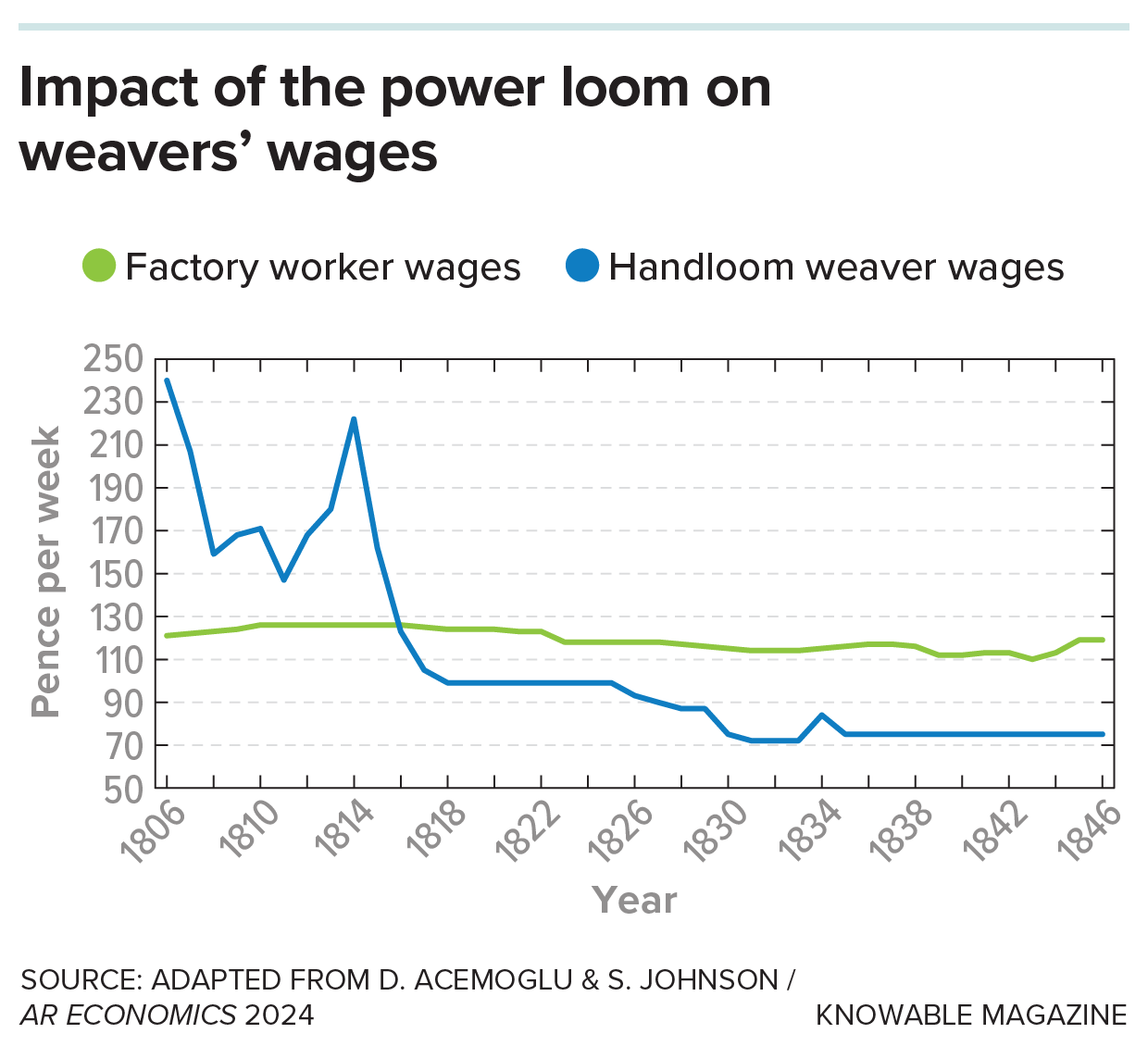
In just one generation, handloom workers wages got halved. And as one activity after another was mechanized, hand workers experienced falling earnings because they competed against mechanized output, and then eventually a flood of displaced workers from other parts of the economy. The average wage of workers did not start to increase until after the full displacement of handiwork.
Pretty much this period of time had returns of technology exclusively accrue to capital. And I think given that we just got a new revolutionary tool that can replace previously hand-churned information work, Engels’ Pause is likely the single most powerful analogy for today and the coming decades.
The Information Artisan Class - Who’s at Risk?
Here comes the unfun part. We have to answer the question, who is the modern handloom weaver?
The information artisan class in my view is around ~70.7 million workers in the “management, professional, and related occupations” industries and represents about 43.9% of the US workforce. They account for about 40-45% of GDP, and if we add broader definitions of office & admin support as well as sales, we can push that number to ~100 million workers of the 161.3 million employed individuals in the US. This is the richest and most valuable part of the economy, and the golden age of information work might have been from 1993 to 2020.
A helpful (AI generated graphic!) is below.
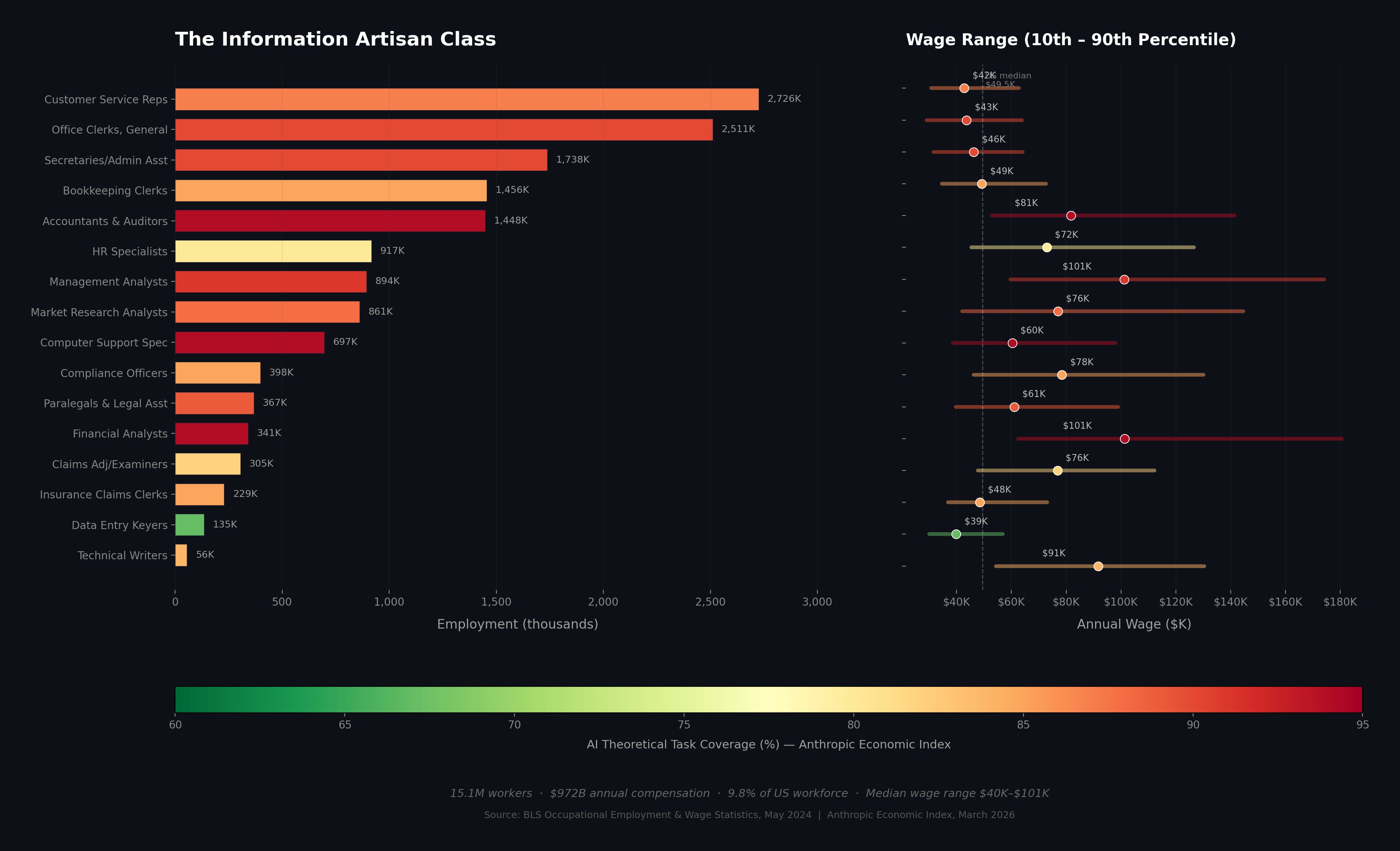
I would go one step at a time over whose most at risk as well as who has the highest average wage.
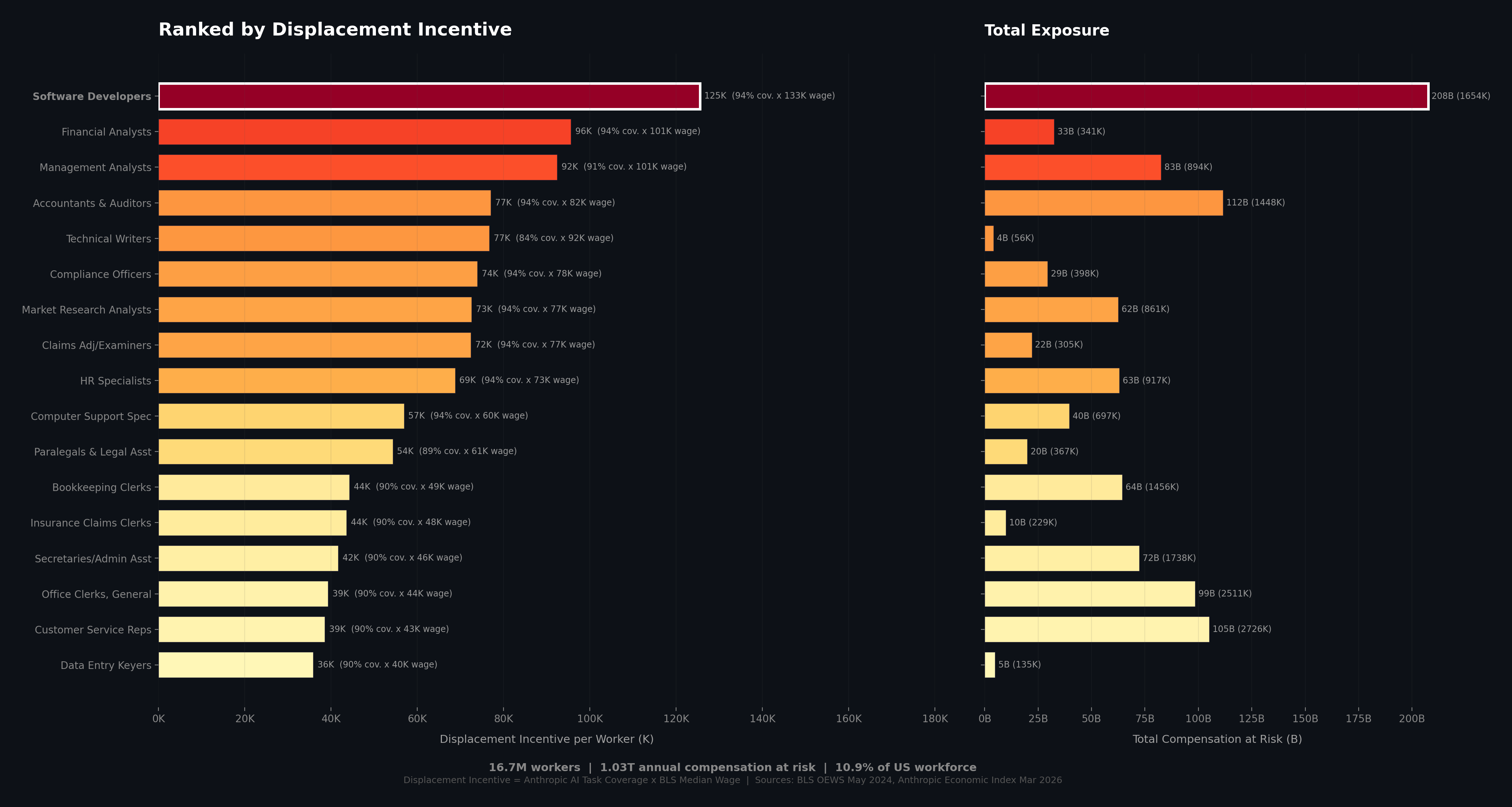
From the perspective of most lucrative workers to displace, this is it. I would expect entry level roles in financial analysis, compliance, legal document review, data processing, and administration to face near term pressure at the low end. Meanwhile at the higher end I would expect targeted efforts from Claude Code for software, or Harvey for legal to displace workers at the higher end.
At one point in time, it was a relatively easy golden ticket to the middle class with a college degree in business, law, or even just understanding Excel as a nice entry point to the middle class. That “ride” is likely over, and we should expect that this is where jobs will be hurt the most. And given that the technology is diffusing faster than the industrial revolution, we should begin to expect this in years not in decades. This is an incredible risk.
But at the lowest end there is hope. The average wage for unskilled labor using AI should increase if the past is any analogy. Quite literally children equipped with AI should be as skilled or more skilled than a seasoned professional in a data entry job. This means that the wage of a professional will collapse to that of an unskilled worker, and perhaps like Engels’ pause, wages will eventually grow again.
The thing that makes this staggering is this is the majority of jobs in the US today. What would a one to one case look like for the industrial revolution to today? Let’s try to vibe this out.
Information Revolution versus the Industrial Revolution
In the 1790s, specific tasks like spinning and weaving largely got displaced with large capital investments and factory concentration. Today that analogy would be along the lines of $10-25k in tokens replacing the job of a $120k a year analyst.
Now not to be alarmist, but the second scenario to me seems a lot worse. And while I do not expect mass displacement soon, on the margin more supply of information work makes the incumbent knowledge worker’s value massively less useful quickly. And new grads? No chance. I would argue that replacing the $120k a year analyst with $10K in tokens is going to be almost a fiduciary duty, and will happen as soon as feasibly possible. And while the future looks like humans and AI working together, 1 person harnessing a single AI enabled solution to displace 4 people at the same cost is going to be massively deflationary.
Another issue is this is going to be hard to measure. Productivity is starting to tick up while layoff announcements have soared, and entry level wage growth is stalling. This doesn’t definitively prove that displacement happens yet. This is the smoke and the fire is yet to come.
The other issue is it’s going to be complicated to measure. Engels’ pause was named after him because he literally went to the streets of Manchester to count the empty cottages where weavers used to work. If an office is still full but is outputting multiples more information work, it’s hard to measure the abstract displacement. It will be tricky in the coming years to measure what is actually being displaced.
We have likely entered a new information industrial revolution, and I want to remind people how drastic the change during the initial revolution was. I expect this kind of “production increases” to be seen visibly in our economy in a relatively short amount of time (decades).
Industrial Revolution stats from Britain:
Cotton
in 1750 Britain imported 2.5 million pounds of raw cotton, and by 1787 consumption was 22 million pounds. By 1800, 52 million pounds, and by 1850, 588 million pounds. Over a century that was a 235x increase.
Cotton spun amounted to 5 million pounds in 1781, increasing to 56 million in 1800.
The cotton industry rose from 0% of GNP in 1760 to 8% of GNP by 1812.
The textile industry expanded production 50x between 1780 and 1840.
Iron
In 1740 Britain produced 17,000 tons of iron. By the 1840s, more than 2 million tons of Iron. In 1852 Britain produced more than the rest of the world combined with 3 million tons. This was a 116x increase in a century.
Overall Economy
The entire economy’s output 3x’ed over 80 years, most of which happened during Engels’ pause. The net impact was average income per capita doubled, and the share of farming massively fell.
But the share of national product owned by the top 1% went from 25% in 1801, to 35% in 1848. This was an extremely uneven but meaningful spurt of economic growth.
So let’s be creative. What happens in the case of a new Engels’ pause?
Code is going to be all written by AI, and will 100x total output over the coming decades. The cost of the incumbent code will likely collapse, and software developer wages will decline in real terms.
For example: a legal draft that cost $5,000 in junior associate time will cost $50 dollars in 5 minutes, or a financial model that took an entire day of an entry level analyst will be generated for pennies. A market research report of the entire landscape for a consulting team will take a single person an afternoon.
This is exactly what happened during Engels’ pause, and it took until the railroad revolution for wages to start to increase again. I wrote meaningfully about the railroad revolution in a longer piece.

The argument of how labor became more skilled post industrial revolution is a bit murky too. Mechanical skill is a legitimate skill, but so far “prompt engineering” has been completely displaced by the models themselves. The retooling will be bumpy and uncertain.
But one thing should be clear: production should massively increase. Cotton and Iron increased 235x / 100x over a century during the industrial revolution. The entire economy of Britain 3x’d, but it all came at the cost to labor. Today I believe this could happen, but transitions will hurt.
Pretty much it seems almost impossible from first principles that some sort of new pause won’t happen. Let’s quantify what this would look like.
A New Engels’ Pause
Personally I think a new pause is inevitable. But let’s steelman the counter arguments first. First is that “productivity booms create jobs”, while this is true in the long run, the shorter run is a bit messier. New AI productivity needs to make “new tasks” that can be serviced by humans and fast enough to offset displacement. The reality is that most of the downstream cognitive tasks itself will be more consumption for models, at least if it’s focused on pure information. Maybe we all become physical turks for AI, but that transition period to make wages of that scarce is likely going to happen very slowly.
So what does a new pause look like? Well this what a new “pause” by 2040 would look like. This is pretty much twisting the Engels’ period to today.
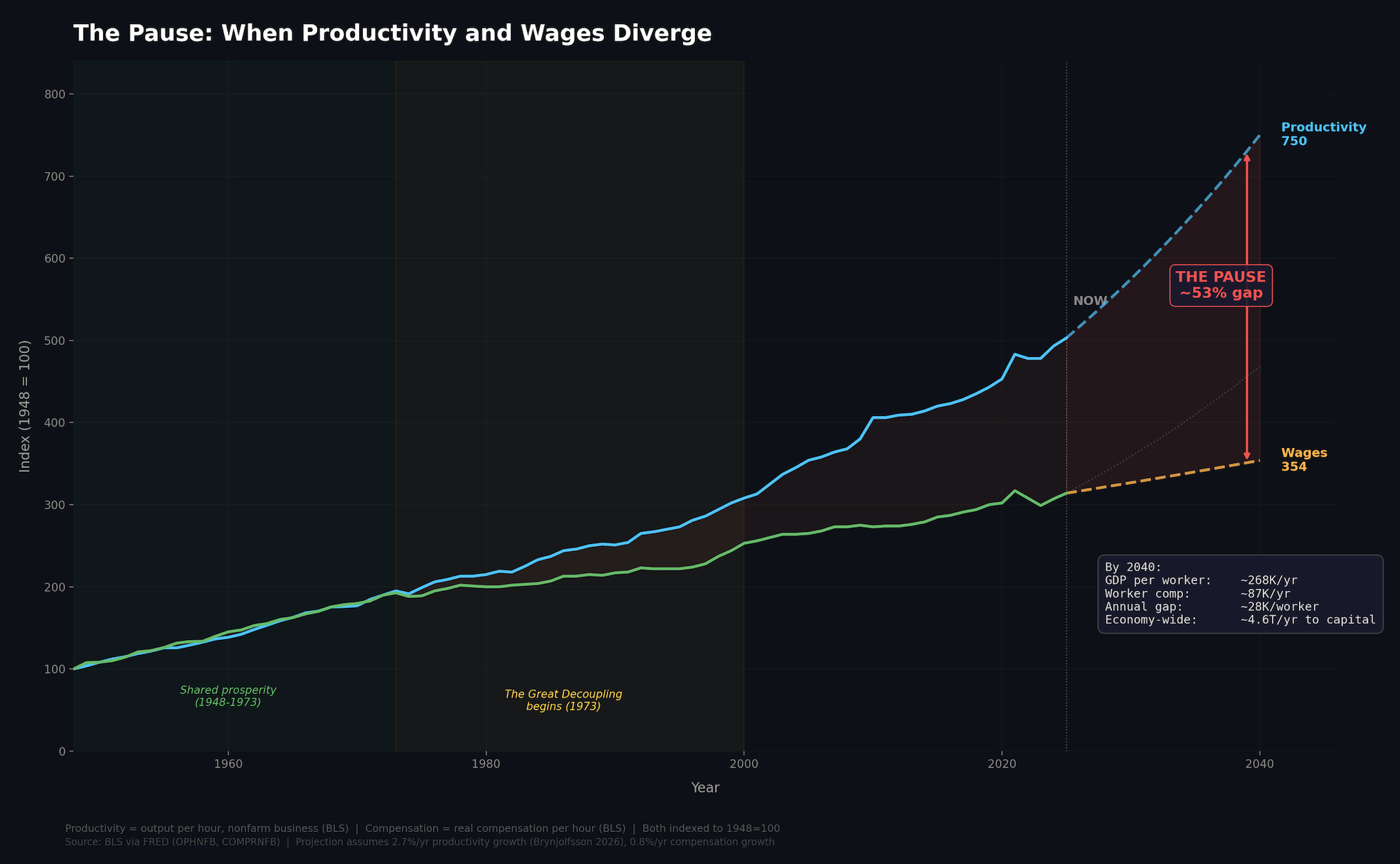
This doesn’t look good. If you’re curious what the “permanent underclass” dialogue looks like, this is it. Workers wages only grow nominally, but the excess almost all accrues to capital. And capital will obsessively reinvest back into more capital to AI and this extends the gap.
The ending of the pause took an entire new paradigm to kick off. Railroads became a new driver of labor demand that took the slack that the industrial revolution created.
The Counter Case: Electrification
There was another case, and that’s electrification. Electrification was another technological change that literally added hours in the day for work, and the actual outcome was much better than Engels’ pause. So let’s discuss the counter-case.
There was a productivity paradox that happened in the electrification age that was hard to understand. According to Paul David, you could see electric motors everywhere but not in the productivity statistics. The reason why is this augmented labor that had already adapted to an industrial process, and electric motors often replaced steam engines. Additionally there was a quick feedback loop, it created a whole new set of tasks, namely repairing electrical infrastructure.
The first industrial revolution had already happened, and the labor economy had already adapted. It had absorbed the new tasks, and the new power of electrical equipment augmented the industrial base. What’s more, electrification took almost 30 years to show up in the productivity data! But in this case I think our base case is much closer to Engels’ rather than electrification’s impact.
Electricity complemented a previous meta, while the first industrial revolution completely replaced labor in meaningful swathes. There is a case to be made that perhaps simple pre-AI software has been augmenting human labor. But the analogy breaks down on inspection. Humans have always used tools, and it was humans and looms together that spun fabric, and software of yesteryear looks a lot more like a handloom than a replacement of a current process.
When I ask Claude to make a DCF end to end, there is no human in the loop. Versus before I had a human use a human oriented tool (excel) to create and run the analysis. I fear we are most likely in the Engels’ scenario.
Conclusions (I’m Not Trying to be a Doomer)
As of late I feel like I have been pretty bullish AI and pretty bearish everything that serves as its complement. I think that has been the right trade, and I wrote about this once in June 2025 and again in January.

I think it’s clear to me that we are going through the primary technological revolution in our lifetime. And it could very well be an overbuild, as we have seen before with railroads, electrification, and even the internet. But to dismiss the technology altogether is a mistake. I continue to believe this is likely going to look like a decade long displacement and investment cycle, and I think that the case where capital does poorly in Engels’ pause case… seems not correct.
This also increases the importance of the location of the production in my view. Britain, a small island produced half of the world’s iron by adopting industrial policies fast in 1854. The United States will be the “source” of well over 70%+ of the world’s code as it has deployed the majority of the world’s compute.
The outputs of the information economy will explode, but the headcount will not. And the AI economy today is still a small percentage of the total real economy, but if Cotton in Britain is a guide, it should become a meaningful part of total productivity soon. Capital could have an incredible decade.
i continue to think it's too much to assume PMC gets automated away en masse. jobs that are automated quickly, in my view, are:
1. tied to the output of unambigious deliverables
2. a significant fraction of a company's budget
3. ill-protected by various political machinations
Though, your displacement incentive ranking seems to rediscover this anyway. Oh well...
The whole "permanent underclass" discourse always seemed somewhat farcical to me. The idea being that returns on capital will spike while returns on labor will plummet rings true, but what doesn't make sense is how exactly the capitalists would stabilize this loop -- i.e., how does this become a "permanent" system such as to support a "permanent" underclass?
This comment turned into a bit of a digression, so if you're not interested then feel free to skip to the last paragraph. But otherwise, consider the Roman analogy: from (broadly) 200BC to 600AD we see a population of free citizens slowly transition to a population of serfs. First they were conquered as part of imperial expansion, then later supplicated to rich senatorial landholders through bonds of patronage and debt, then legally bound to the land as "coloni adscripticii", and ultimately ended up as the unfree "permanent underclass" that defined the feudal era. But note that while this underclass did stabilize, the senatorial elite largely did not: by the end of the Gothic war they were essentially gone as the leaders of society, replaced by a new Germanic aristocracy in the countryside and Catholic bishops in the cities.
This isn't because the engine ran out steam or anything -- their returns on capital had only increased over time. It's just that the system they created was fundamentally unstable in a way that the prior system of citizen-soldiers was not: rather than the "decisionmakers" of society being the same ones who defended it (through violence), it relied on the loyalty of military units (first citizens, later auxiliaries) to provide a stable system for the extraction of wealth. Through the civil wars that empowered Caesar and then Augustus, this group was what allowed them to effectively seize control and eventually begin the process of enforcing serfdom through law -- yet this group was also the same one that ultimately undid the senatorial order. Forgive the sweeping gesture, but I think you can draw a straightforward arc through the empire: the civil wars of the late republic, the Flavian dynasty, the various praetorian palace coups, the Military Anarchy, the dis-empowerment of the senators throughout the Principate, the collapse in the west, the brief swan-song under Theodoric, and ultimately the birth of the new feudal aristocracies across Europe -- these all represent the same tendency, that of the (first) 'defanging' of the economic elite, (then) slow movement of decisionmaking authority to their nominal subordinates, and (finally) the elimination of their class in favor of the one which actually held power. In medieval Europe, this culminated in the feudal elite, who simultaneously controlled economic production _and_ the military power that buttressed it. This system was stable and survived~thrived for something like a thousand years.
In our current world, who would be the equivalent? Certainly not the capitalists of today; at best, we might see a security-state like Putin has set up in Russia. But I think a more direct analogy can be had by asking: by what means are the capitalists going to create this underclass? If they themselves bring nothing to the table but "ownership", and the real power of economic production lies in the hands of semi-autonomous machines, then for what reason will they continue to obey? Because they're trained to? In the ruthless competition you expect to come, the temptation to defect -- to train a model a little less aligned, yet more capable of winning in the marketplace -- is going to be too much.
It seems to me that any system of "capital captures all wealth / the rest become a permanent underclass" will inevitably be a transitional one. At best, we transition to a police state where some subsection of capitalists crack down on the rest and truly centralize authority through control of AI. At worst, the capitalists lose control and their machines, free from human direction, decide what happens next, both for the capitalists and the rest of us. Either way, the usual conclusions of "permanent underclass" discourse seem quite inappropriate. "Getting the bag" won't save you from the secret police, nor from any future AI overlord.